
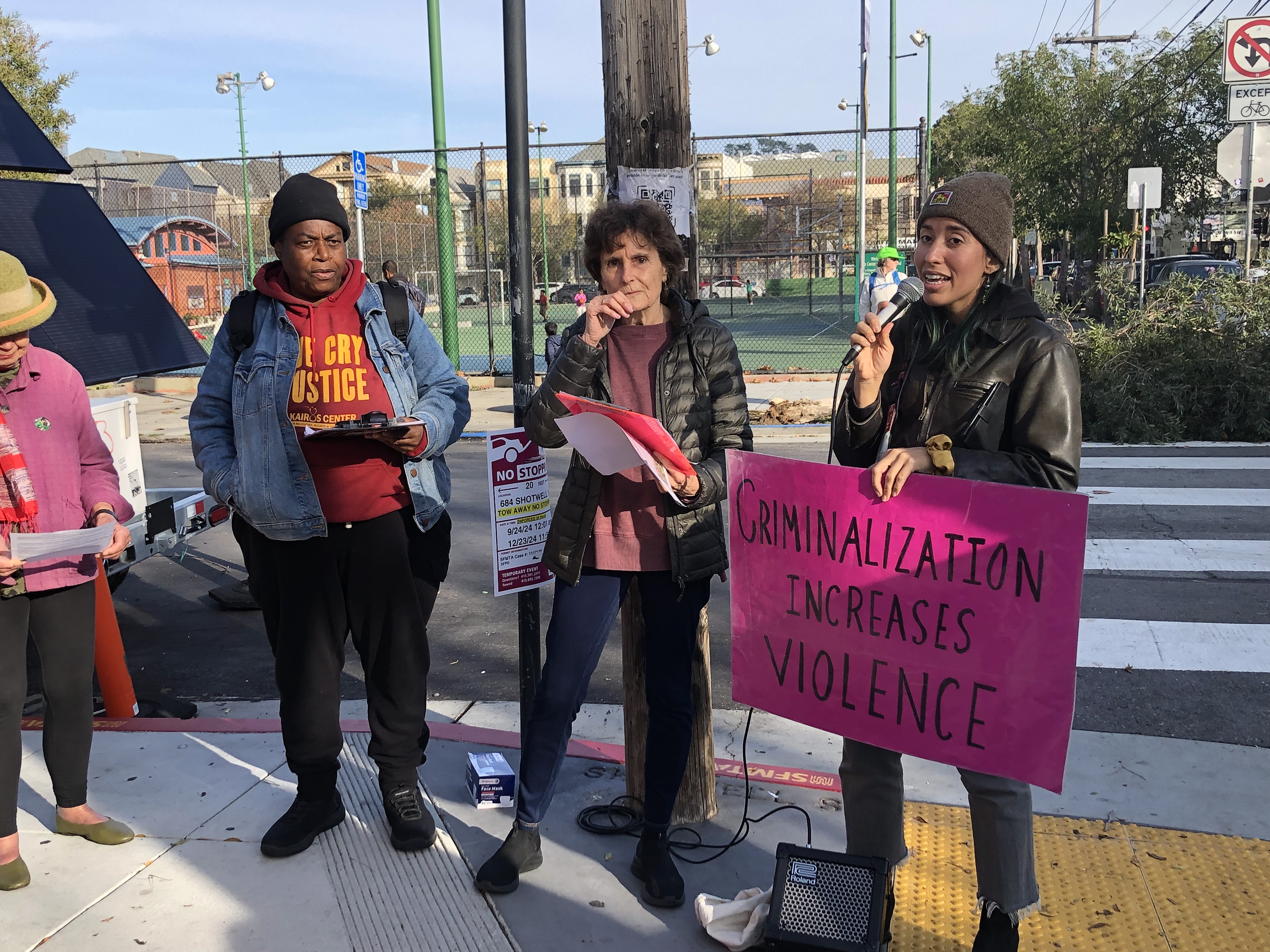
On December 15, 2024, US PROStitutes Collective and others held an action to protest the new high tech surveillance cameras in the Mission district. Protestors stood on the corner of Shotwell and 21st beside one tower where the cameras are mounted to mark International Day to End Violence Against Sex Workers. The action was called by the US PROStitutes Collective, In Defense of Prostitute Women’s Safety Project with the support of Global Women’s Strike, Women of Color/GWS, Nuevo Sol Day Laborers and Domestic Workers.
The high tech surveillance cameras target sex workers, but also immigrants, people of color, homeless people and other discriminated against communities. Speakers asked how many people will be arrested and prosecuted based on the information gathered by these huge roaming cameras. Will the data from these cameras be used by those who threaten to round up and deport immigrants?
Protestors questioned putting financial resources into surveillance cameras that spy on and criminalize us and called for the millions being spent on this expensive technology to be put instead towards ending poverty, including affordable housing, health care, measures like guaranteed care income, child tax credit and other resources. The event was held on December 15th to also support national efforts that call for the reinstatement of a fully refundable Child Tax Credit.
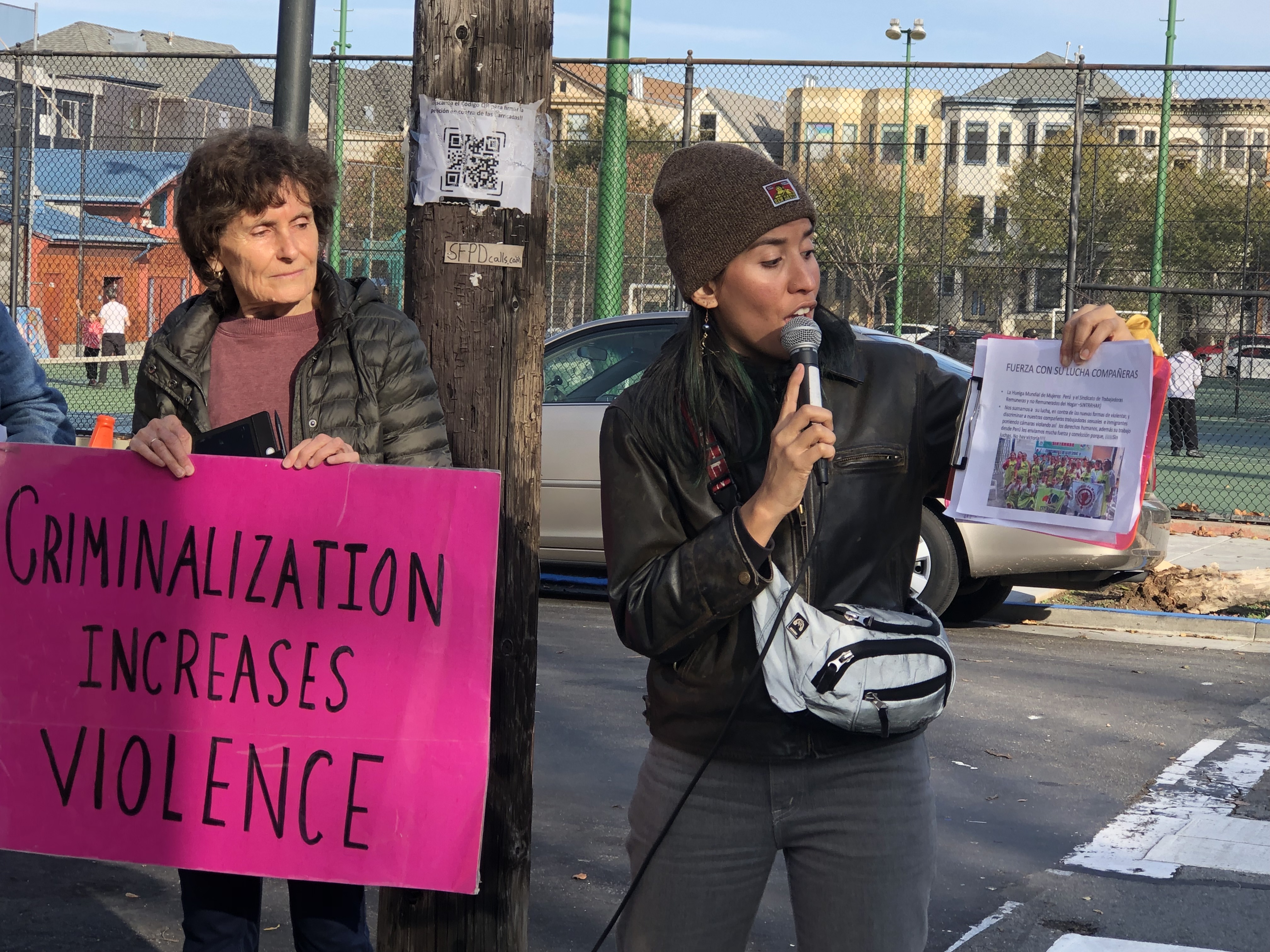
Above is a reading in English and Spanish of a message of support for our action from the Global Women’s Strike in Peru and the El Sindicato de Trabajadoras Remuneradas y No Remuneradas del Hogar, a domestic workers organization in Peru.
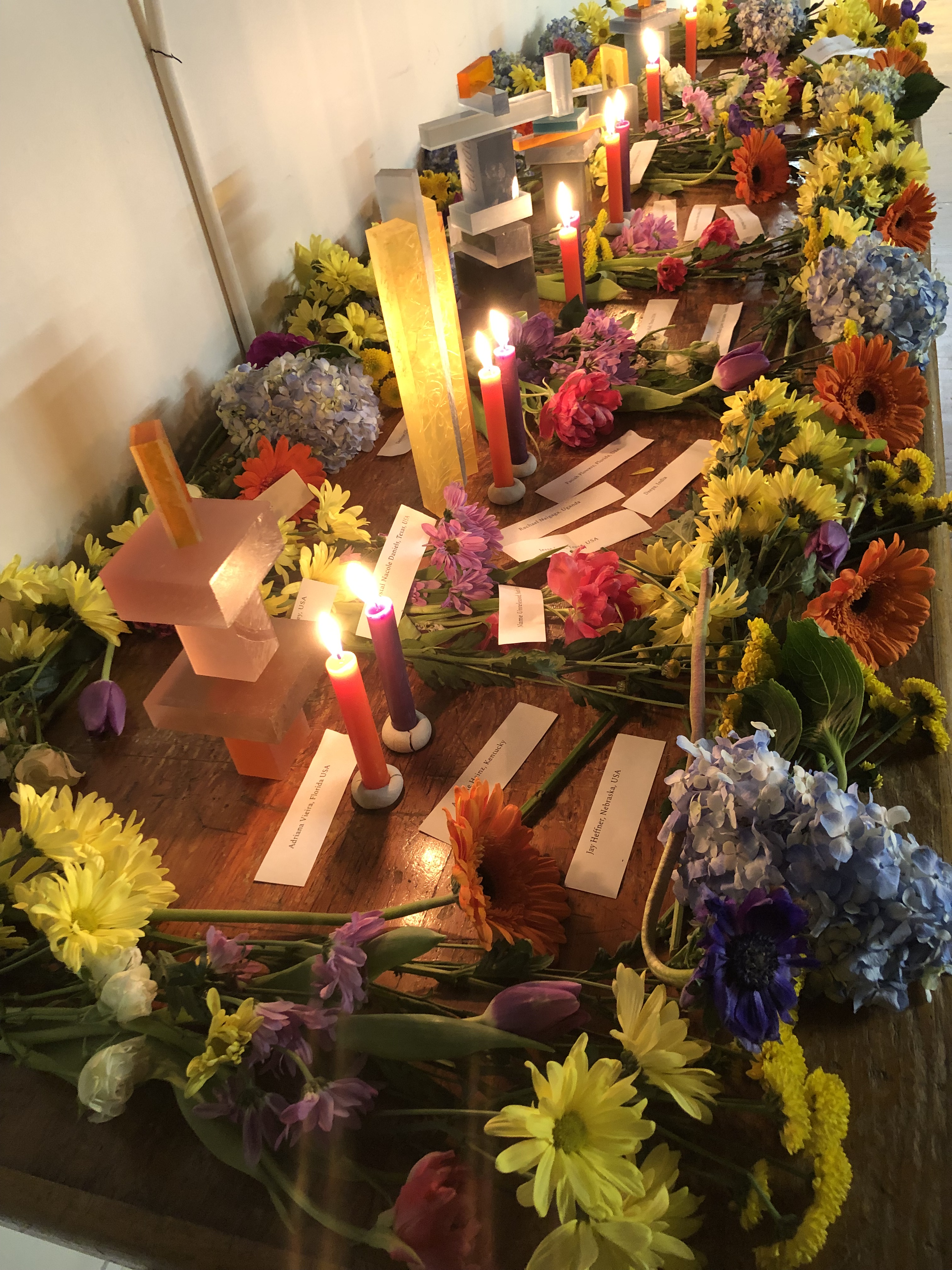
At the indoor gathering following the protest, we commemorated the sex workers who have lost their lives while working with a “Say Their Names” Altar and the reading of their names.
Media Coverage of the Stand-In Protest
See Mission Local coverage of the protest by Kelly Waldron, “Protesters demand removal of sex-work-surveillance cameras in Mission,” December 15, 2024.
KQED Newscast, December 14, 2024.
Surveillance/Spy Cameras Coming to Your Neighborhood: Fact Sheets in English and Spanish

● San Francisco is the fifth most surveilled cities in the US. The city has recently installed three mobile surveillance/spy cameras including at 21st and Shotwell Streets. They are mounted on 22-foot poles, with flood lights, and speakers for round-the-clock monitoring.The cameras are equipped with artificial intelligence, and can be controlled remotely allowing police to surveil an area in real time.
● A 2020 report from the California State Auditor found that agencies they reviewed (Fresno Police Department, Los Angeles Police Department, Marin County Sheriff’s Office, and Sacramento County Sheriff’s Office) were collecting large amounts of data without following state law or some of the most basic cybersecurity and civil liberties concerns when it comes to Californians’ data.
● The pretext for these cameras is for public safety and to deter crime. But before the installation of the surveillance cameras, overall crime numbers in San Francisco were down including: burglaries, property crime, car break-ins, retail theft and violent crime.
● Some neighbors living in the vicinity of the camera on Shotwell/21st are reported not happy with the constant blue lights all night of the cameras and are worried about their privacy. “I know that our neighbors have ring cameras and things, but to have a large surveillance camera show up right outside your living room that can see into your living room and your bedroom at night — it’s upsetting, and it’s frustrating,”
● Rather than putting resources into alleviating poverty and services including rehab and affordable housing, $ millions are being spent to spy on us in our neighborhoods. San Francisco Police Chief William Scott said that one mobile security camera would be deployed to areas known for sex work, like the Mission.
● In the context of the income divide in SF, poverty driving women into sex work, the threatened roundups and deportation of immigrants and their families, these cameras won’t serve protect us but will help to criminalize sex workers, immigrants, homeless people and others who are vulnerable.
● DA Brooke Jenkins said the cameras will be used for prosecutions. Increased law enforcement against sex workers makes them less safe. Sex workers are pushed out to more isolated areas and more at risk of rape and other violence. Law enforcement is implemented in a racist and discriminatory way, disproportionately impacting Black, Brown and Trans women.
● Immigration authorities (ICE) use information gathered in data bases like these cameras to locate, target and deport immigrants including day laborers. The American Civil Liberties Union (ACLU) urges citizens to oppose these centralized mass-surveillance systems in their communities.
How Much Money is Spent on these cameras?
● Installing and maintaining these cameras costs millions of dollars. Each mobile camera costs $30,000 to $40,000 a year to operate. In addition, earlier in 2024 a centralized mass-surveillance system of 400 cameras were installed at intersections citywide, funded by a $17.3 million grant from the California Organized Retain Grant Program.
Fighting Back Vs Mass Surveillance/Spying
● The Electronic Frontier Foundation (EFF) calls mass surveillance a public safety threat. In June the US Department of Homeland Security released an advisory that some Automated License Plate Readers are vulnerable to cyber-attack.
● California agencies collect billions of license plate scans and 99.9% of this data is unrelated to any public safety. If accessed by malicious parties, the information could be used to harass, stalk, or even extort innocent people.
● In 2022, Marin County and the Sheriff’s Department were forced to settle a lawsuit brought by long-time Marin County residents, the ACLU and the EFF. The suit was on the basis that the Sheriff’s office was illegally sharing automatic license plate recognition data with ICE and at least 424 out-of-state agencies and 18 federal agencies, including U.S. Immigration and Customs Enforcement (ICE) and Customs and Border Protection.
● Under the Marin County settlement, the Sheriff and his successors must abide by two state laws: SB 34 which prohibits sensitive data, collected by surveillance cameras, from being transferred to federal and out-of-state agencies, and SB54, which prevents state and local resources from being used to assist federal immigration enforcement.
● In 2020, the Marin County Sheriff’s department recorded 821,244 scans of license plates and specific location information with the ALPR readers. Out of all the license plate images gathered, only 216 “hits” were found, a mere 0.02%.
Issued by: US PROStitutes Collective, In Defense of Prostitute Women’s Safety Project, Global Women’s Strike, Women of Color/GWS and Crossroads Women’s Center.
Cámaras de vigilancia/espía llegarán a su vecindario
● Recientemente, San Francisco ha instalado recientemente tres cámaras móviles de vigilancia/espinaje, incluso en las calles 21 y Shotwell. Están montados en postes de 22 pies, con reflectores y parlantes para monitoreo las 24 horas. Las cámaras están equipadas con inteligencia artificial y pueden controlarse de forma remota, lo que permite a la policía vigilar un área en tiempo real. San Francisco es la quinta ciudad más vigilada de EE.UU.
● Un informe de 2020 del Auditor del Estado de California encontró que 4 agencias (la Policia de Fresno, la Policia de Los Angeles, el Sheriff del Condado de Marín, y el Sheriff del Condado de Sacramento) estaban recopilando grandes cantidades de datos sin seguir la ley estatal ni algunas de las preocupaciones más básicas de los residentes.
● Antes de la instalación de las cámaras de vigilancia, las cifras generales de delitos en San Francisco habían disminuido, incluyendo: robos, delitos contra la propiedad, robos de automóviles, robos en tiendas minoristas y delitos violentos. Pero el pretexto de estas cámaras es la seguridad pública y la disuasión de delitos.
● Algunos vecinos que viven cerca de la cámara en Shotwell con 21st no están contentos con las constantes luces azules de las cámaras durante toda la noche y están preocupados por su privacidad. “Sé que nuestros vecinos tienen cámaras de timbre y cosas así, pero tener una cámara de vigilancia grande justo afuera de su sala de estar que pueda ver su sala de estar y su dormitorio por la noche es perturbador y frustrante”.
● En lugar de destinar recursos a aliviar la pobreza y servicios que incluyen medidas como un sueldo guarantizazo y viviendas asequibles, aceso a comida nutritativa, y prevision de salud, se están gastando millones de dólares para espiarnos en nuestros vecindarios. El jefe de policía de San Francisco, William Scott, dijo que se desplegaría una cámara de seguridad móvil en áreas conocidas por el trabajo sexual, como la Misión. La pobreza, la falta de trabajos con sueldos dignoas, y la falta de la equidad en los sueldo llevan a las personas al trabajo sexual.
● En el contexto de la división de ingresos en SF, la pobreza que lleva a las mujeres al trabajo sexual, las amenazas de redadas y deportaciones de inmigrantes y sus familias, estas cámaras no servirán para protegernos pero ayudarán a criminalizar a las trabajadoras sexuales, los inmigrantes, las personas sin hogar y otros que son vulnerables.
● La fiscal de distrito Brooke Jenkins dijo que las cámaras se utilizarán para los procesamientos. Una mayor aplicación de la ley contra las trabajadoras sexuales las hace menos seguras. Las trabajadoras sexuales son expulsadas a zonas más aisladas y en mayor riesgo de sufrir violaciones y otros tipos de violencia. La aplicación de la ley se aplica de forma racista y discriminatoria, lo que afecta desproporcionadamente a las mujeres negras, morenas y trans.
● Las autoridades de inmigración (ICE) utilizan información recopilada en bases de datos como estas cámaras para localizar, atacar y deportar inmigrantes, incluidos los jornaleros. Dados los planes de acorralar y deportar a inmigrantes y sus familias de cuidadanos estadounidenses, esto solo aumentará. La Unión Estadounidense por las Libertades Civiles (ACLU) insta a las personas a oponerse a estos sistemas centralizados de vigilancia masiva en sus comunidades.
¿Cuánto dinero se gasta en estas cámaras?
● Instalar y mantener estas cámaras cuesta millones de dólares. El funcionamiento de cada cámara móvil cuesta entre 30.000 y 40.000 dólares al año. Además, a principios de 2024 se instaló un sistema centralizado de vigilancia masiva de 400 cámaras en las intersecciones de toda la ciudad, financiado por una subvención de $17,3 millones del Programa de Subvenciones de Retención Organizada de California.
Contraataque versus vigilancia y espionaje masivos
● La Electronic Frontier Foundation (EFF) califica la vigilancia masiva como una amenaza a la seguridad pública. En junio, el Departamento de Seguridad Nacional de EE. UU. publicó un aviso de que algunos lectores automatizados de matrículas son vulnerables a ataques cibernéticos.
● Las agencias de California recopilan miles de millones de escaneos de matrículas y el 99,9% de estos datos no están relacionados con la seguridad pública. En el año 2020, el Departamento del Sheriff del Condado de Marín anotó 821,244 escaneos de patentes de autos con informacíon específica de su ubicación. De todos los imagenes de las patentes registrados, solo 216, o 0.02%, fueron de “resultados”. Si personas malintencionadas acceden a la información, ésta podría utilizarse para acosar, acechar o incluso extorsionar a personas inocentes.
● El condado de Marín y el Departamento de del Sheriff se vieron obligados a llegar a un acuerdo en una demanda presentada por residentes del condado de Marin desde hace mucho tiempo, la ACLU y la EFF. La demanda se basó en que la oficina del Sheriff estaba compartiendo ilegalmente datos de reconocimiento automático de matrículas con ICE y al menos 424 agencias fuera del estado y 18 agencias federales, incluido el Servicio de Inmigración y Control de Aduanas (ICE) de EE. UU. y la Oficina de Aduanas y Protección Fronteriza.
● Según el acuerdo del condado de Marin, el Sheriff y sus sucesores deben cumplir con dos leyes estatales: la SB 34, que prohíbe que los datos confidenciales recopilados por las cámaras de vigilancia sean transferidos a agencias federales y fuera del estado, y la SB 54, que impide que las autoridades estatales y recursos locales se utilicen para ayudar a la aplicación federal de la ley de inmigración.
Emitido por: US PROStitutes Collective, Proyecto En Defensa de la Seguridad de las Mujeres Prostitutas, Global Women’s Strike, Women of Color/GWS y Crossroads Women’s Center.
 US PROS Collective